When we talk about renewable energy, one question comes up time and again: How can all families—especially renters, seniors, and working-class households—find a way to participate and save money?
Right across our state border in Illinois, a case study published by The Pew Charitable Trusts offers an answer. Highlighting a 2-megawatt community solar project in suburban Chicago, Pew’s research demonstrates how state-supported community solar policy can deliver guaranteed savings directly to residents who can’t put panels on their own roofs.
The case study explains how community solar opens up clean energy benefits to customers often left out of the market:
“The flyer introduced Dianne to community solar, a type of distributed energy resource that allows consumers to benefit from solar energy without installing panels on their roofs. For renters or households unable to afford upfront installation costs, community solar opens access to energy savings that otherwise would be out of reach. Amid rising energy costs across the country, this approach not only supports cleaner energy but provides a pathway to more affordable bills.”
The real-world impact for local residents on fixed or modest incomes is immediate and measurable:
“Because the Torrence project predominantly serves communities with low-to-moderate household incomes, it plays an important role in addressing energy burden, a metric that defines the percentage of income a household spends on electricity bills. On average, low-income households have an energy burden of 6%, which is three times higher than that of other households… Through discounted electricity rates, subscribers receive guaranteed savings on their energy bills. During its first year of operation… the Torrence project delivered an estimated $186,000 in total customer savings.”
Furthermore, the case study shows that community solar isn’t just about reducing utility bills. It’s also an economic engine for the broader community, supporting local agriculture through dual-use practices like solar grazing and creating local construction and maintenance jobs:
“Development and construction activities—including more than $3.5 million in local and regional supplier spending and the generation of more than $1 million over the next 20 years from property taxes and lease payments—have further supported the local economy.”
As Illinois demonstrates, when policymakers establish frameworks that allow community solar to thrive, everybody wins: ratepayers save money, local governments gain tax revenue and agricultural families gain new income streams.
As utility bills continue to climb and expensive fossil fuels continue to present health risks, we’re hopeful that Indiana will embrace policies that give Hoosier families these same choices.
This piece was originally published by the Youth Environmental Press Team, which elevates the voices of middle school, high school and college journalists writing about the environment and the climate crisis.
The author is a rising Sophomore at Indiana University. While it is normally YEPT’s mission to publish middle and high school writers, we occasionally make an exception for college students when the student has past experience with YEPT or our parent organization, Earth Charter Indiana. In this instance, Jamie began working with ECI in 2015, and has continued to in various capacities. Jamie is currently interning with Solar United Neighbors as part of the McKinney Climate Fellows program.
What is Community Solar?
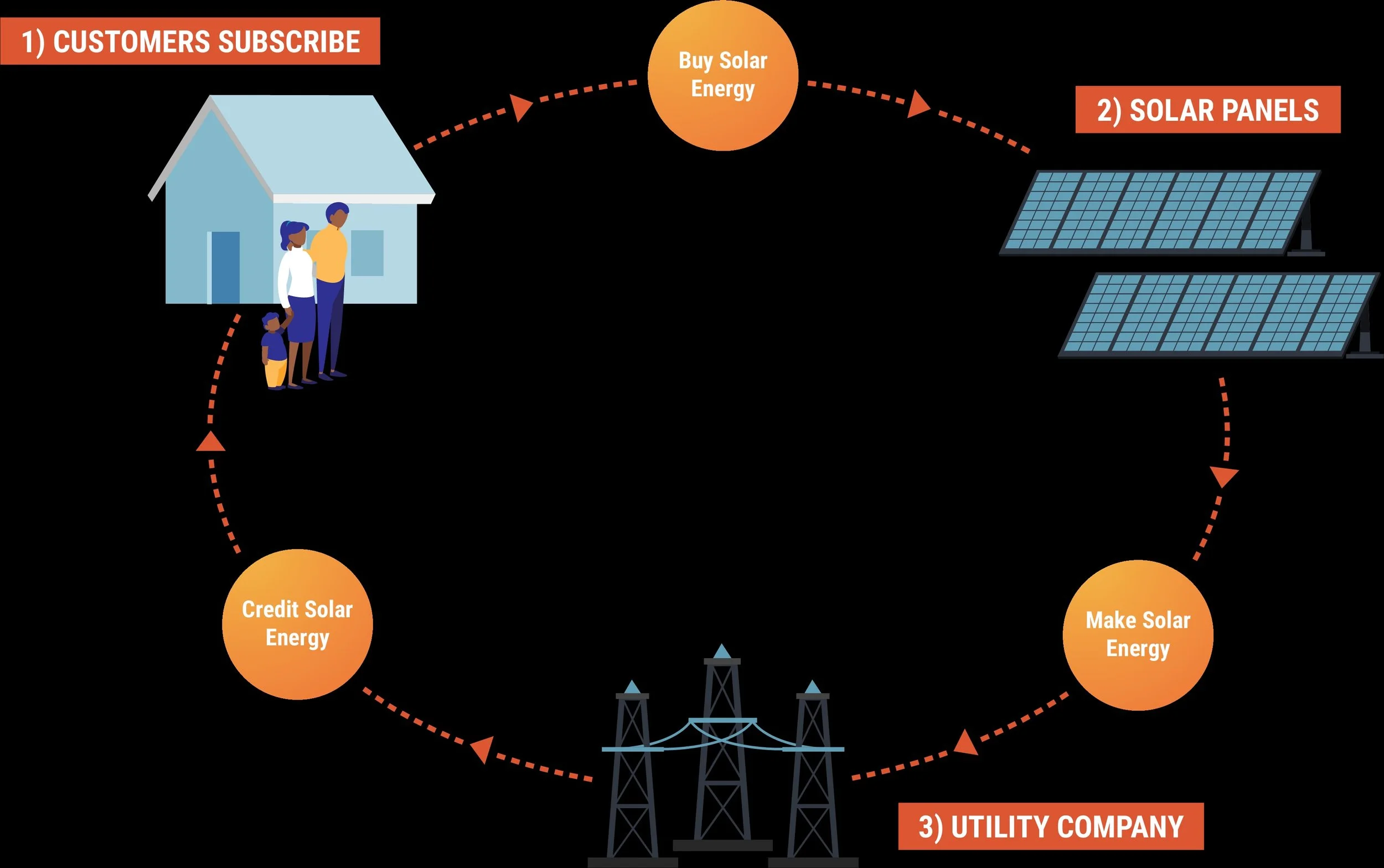
Community solar is a way to make solar and energy savings more accessible for all. Many people want to go solar but are unable to do so due to the configuration of their roof, surrounding tree coverage, their ability to afford the initial investment, or because they don’t own their home. With community solar, customers can subscribe to, or in some cases own, a share of the energy generated by off-site solar panels. Customers then receive a credit on their electric bill for the electricity generated by their portion of the community solar system.
Benefits of Community Solar
Participating in community solar can lower your energy bill by around 10%, according to Solar United Neighbors, while also reducing your carbon footprint. On a larger scale, it benefits the community and the environment by decreasing reliance on fossil fuels and improving the resilience of the electrical grid.
Community solar aims to give back to the community in more ways than just energy. Depending on the project and the level of community involvement, people may have the opportunity to participate in a cooperative that makes decisions on developers, location, and other aspects best aligned with the community’s values. Even without a cooperative, many programs aim to use community solar to enrich communities. This includes employing local labor for construction and maintenance. Hoosier Environmental Council cites a study from WorkingNation, which predicts that, over the next 5 years, the demand for green jobs in Indiana will increase by nearly 30%. Community solar is a great way to allow those jobs to support communities directly.
Solar arrays are also a great way to make unused land productive and sustainable. This includes brownfields, rooftops, and farmland that does not yield crops. According to Keith Hevenor, Communication Manager for Nexamp, a national clean energy company, land is typically leased for the duration of a community solar project, around 20-25 years. This benefits local landowners by generating passive income from unused land without having to sell. Often, these are farmers with land that is unusable or unproductive for crop yield. It provides steady, predictable, long-term income that can be used to strengthen family farms, further supporting the community. Each project also has a decommissioning bond associated with it, so that at the end of the lease, if either party decides not to renew, the solar farm can be decommissioned, recycled, and the land is ready for a new life.
Community solar supports people and local businesses at all levels. It empowers communities to take control of their energy production, making affordable, clean energy accessible.
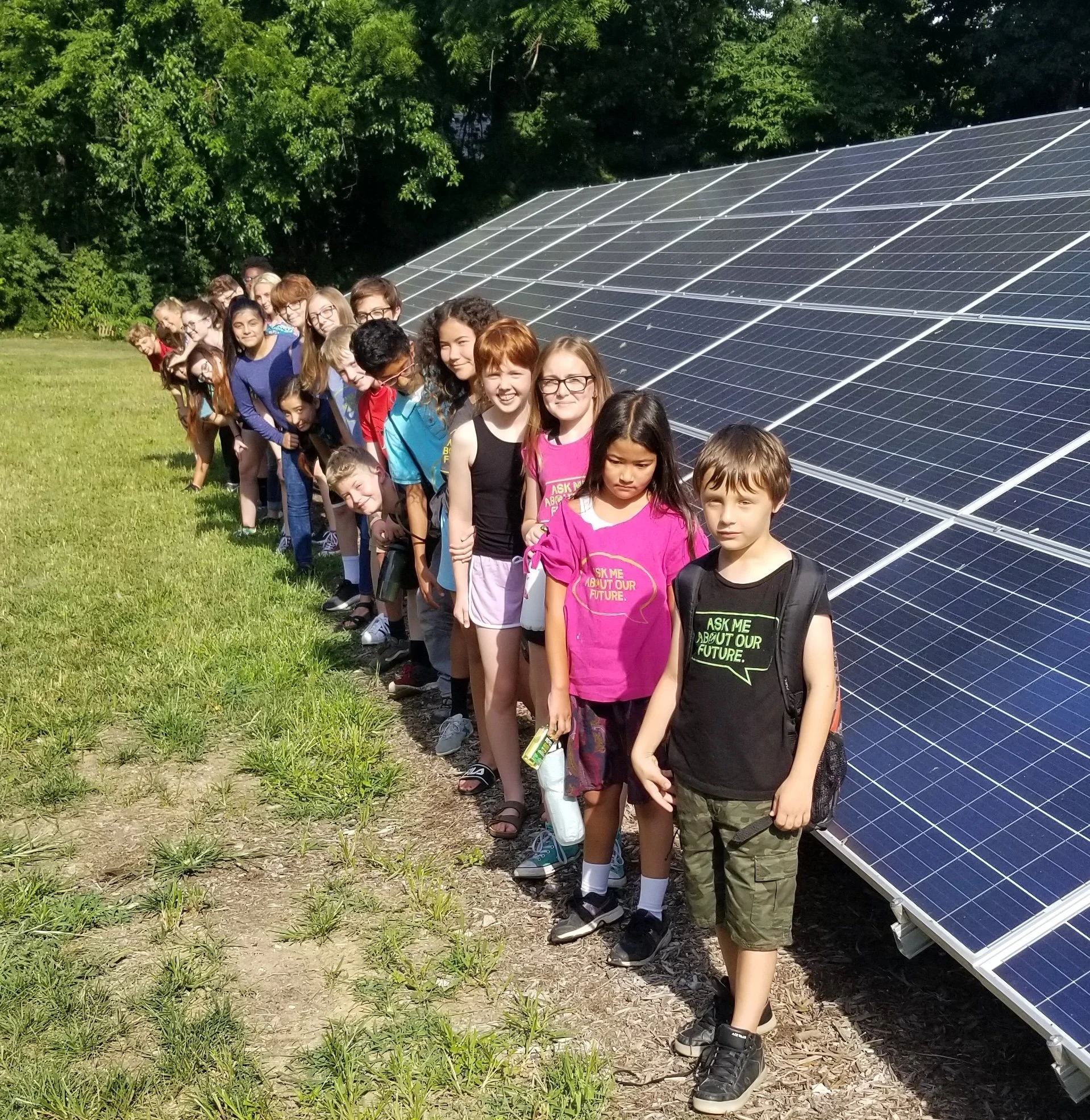
The author, Jamie, learned about solar power from an early age, here pictured (circa 2017), fourth child from the right, with fellow elementary aged students in one of ECI’s summer camps. Provided photo.
What’s a community solar subscription?
In conversations with Keith Hevenor, he walked me through the process that Nexamp and many other community solar companies go through to set up a new community solar program and then allocate that energy to a new subscriber.
Most community solar companies, including Nexamp, operate on a subscription model. However, the phrase “subscription model” can lead to some misunderstanding. Unlike a streaming service or other typical subscriptions, a community solar subscription is not a fixed amount every month; it is variable, depending on the amount of energy used and generated.
Community solar operates in partnership with local utility companies. As energy is generated, it is sent to the grid. The energy generated by the solar arrays is translated into credits, which are applied to the bills of subscribers. Furthermore, there is a fixed discount off the energy bill for participating in community solar (the percentage varies depending on the state). It is most commonly a two-bill system: one from the utility company with the applied credits, and one from the community solar company for the energy, which includes the discount. This can be confusing, but rest assured that it does result in overall savings, and community solar companies are working to consolidate bills to simplify the process.
To set up a subscriber with community solar, a company will review the subscriber’s energy usage over the past 12 months and then allocate a portion of the community solar array to cover the subscriber’s electricity needs for the year. Energy usage is looked at on an annual basis to account for the longer summer days and shorter winter days, which result in varying solar energy production. Due to variable energy consumption and production, energy bills and credits will differ every month and should balance out at the end of the year.
This variability may not be suitable for households living paycheck to paycheck. In those instances, programs like Illinois Solar for All, which are geared towards low- to moderate-income customers, offer opportunities to flatten the monthly bill based on estimated energy consumption. This is similar to traditional budget billing with a utility company. At the end of the year, the final bill will be adapted to reflect the actual balance.
Additionally, some local and state governments subsidize companies to offer community solar to low- or moderate-income residents. These savings are passed on to subscribers in the form of a higher discount, further reducing the energy burden and increasing accessibility for solar energy.
It is worth noting that, although much of this process is based on annual data, the program and subscriptions are typically month-to-month. There is usually no enrollment or cancellation fee; however, cancellation may not be immediately available because of the relationship between the community solar company and the utility company. Community solar companies submit a list of customers and the amount of credits that should be allocated to each household to the utility company. If a subscriber wants to cancel, they will be removed from the list. However, utility companies often only accept updated lists at specific times, such as quarterly.
Community ownership is similar, but operates without a community solar company owning the solar arrays. Instead of a community solar company, the arrays are owned by community members, often in a cooperative. According to Diana Eddowes, Director of Community Access for Solar United Neighbors, this approach can allow for more freedom in the decision-making process, but it also requires a significant amount of time and effort. It also allows owners to earn passive income from the excessive energy produced.
Federal funding can support community solar projects. In Indiana, where there is currently no legislation that creates a clear path forward for developing community solar projects, federal funding can be critical. One major funding opportunity comes from Solar for All, a $7 billion program from the U.S. Environmental Protection Agency (EPA), supporting 60 grant recipients to expand or establish low-income solar programs. These programs will enable more than 900,000 households in low-income and disadvantaged communities to benefit from distributed solar energy. While federal policy changes have created an environment of uncertainty, as of this writing the Solar for All Program is moving forward.
Hoosiers will benefit from Solar Opportunities Indiana, a $117.4 million Solar for All Program being administered by Indiana Community Action Association, Inc. (IN-CAA) and several other local governments and nonprofits. Two community solar projects receiving funding from Solar Opportunities Indiana are featured below.
Columbus, Indiana
To learn more about the Doug Otto Community Solar Project, I met with Mike Mullett, a member of the Energy Matters Community Coalition, Inc.
The Doug Otto Community Solar Project is a proposed plan where the arrays would be owned by the Doug Otto United Way Center, a community center that provides various social services to low-income communities. Due to legal regulations, at least 50% of the energy generated would need to be sold to Duke Energy, their local utility company, with the rest going to the Doug Otto Center, which would offset their Duke Energy bill.
Mullet says, “As we understand, other people cannot provide energy other than the regulated utilities. With consent from Duke and approval from [the Indiana Utility Regulatory Commission], the Doug Otto subscription to community solar would be lawful.”
Through good faith negotiations and a letter of commitment from Duke Energy, it is proposed that the proceeds from the energy sold to Duke Energy would be used to provide energy to 300-400 low-income households. The proceeds would be deposited into an escrow account at Duke to credit the bills of subscribing low-income customers, which would be an unconventional approach but entirely within Duke’s authority.
This proposed plan would be groundbreaking for community solar in Indiana, paving the way for future investments in communities and clean energy.
Fort Wayne, Indiana
Fort Wayne, Indiana, is also working towards community solar from a municipal standpoint. I spoke with Kerry Korpela about how their upcoming project utilizing community solar will benefit Fort Wayne’s citizens. Korpela is the program manager for the City of Fort Wayne’s Climate Action and Adaptation Plan, as well as the Fort Wayne City Utilities Envision Initiative.
To bring relief to those who are most economically disadvantaged and experience steep energy burdens, they are turning to community solar. “Having a community model is crucial when working in an area with older housing stock. Older roof and wiring replacement can be prohibitively expensive when trying to integrate solar,” Korpela explained.
The envisioned project started with the idea of delivering savings directly to people’s electric bills. The solar array would be City-owned and operated as a traditional subscription-based community solar program. “It’s been a complex process, navigating the realities of community solar. We’re working hard to create a model that works for Fort Wayne residents.”
Korpela highlights the necessity of affordable energy in Fort Wayne. Many families can’t afford electricity, so they turn on gas stoves and ovens to warm their spaces. Community solar not only fuels homes, but the savings can also fuel families. As Korpela says, “$100 can be the difference between buying your kids food or not.”
Korpela has seen firsthand the excitement that communities have for this endeavor. “I’ve been working with the East Central Neighborhood in Fort Wayne and have seen the way people are excited for a project like this. It gives them hope.”
Savings from community solar can rebuild cities, support families, and create a cleaner future for the next generation.
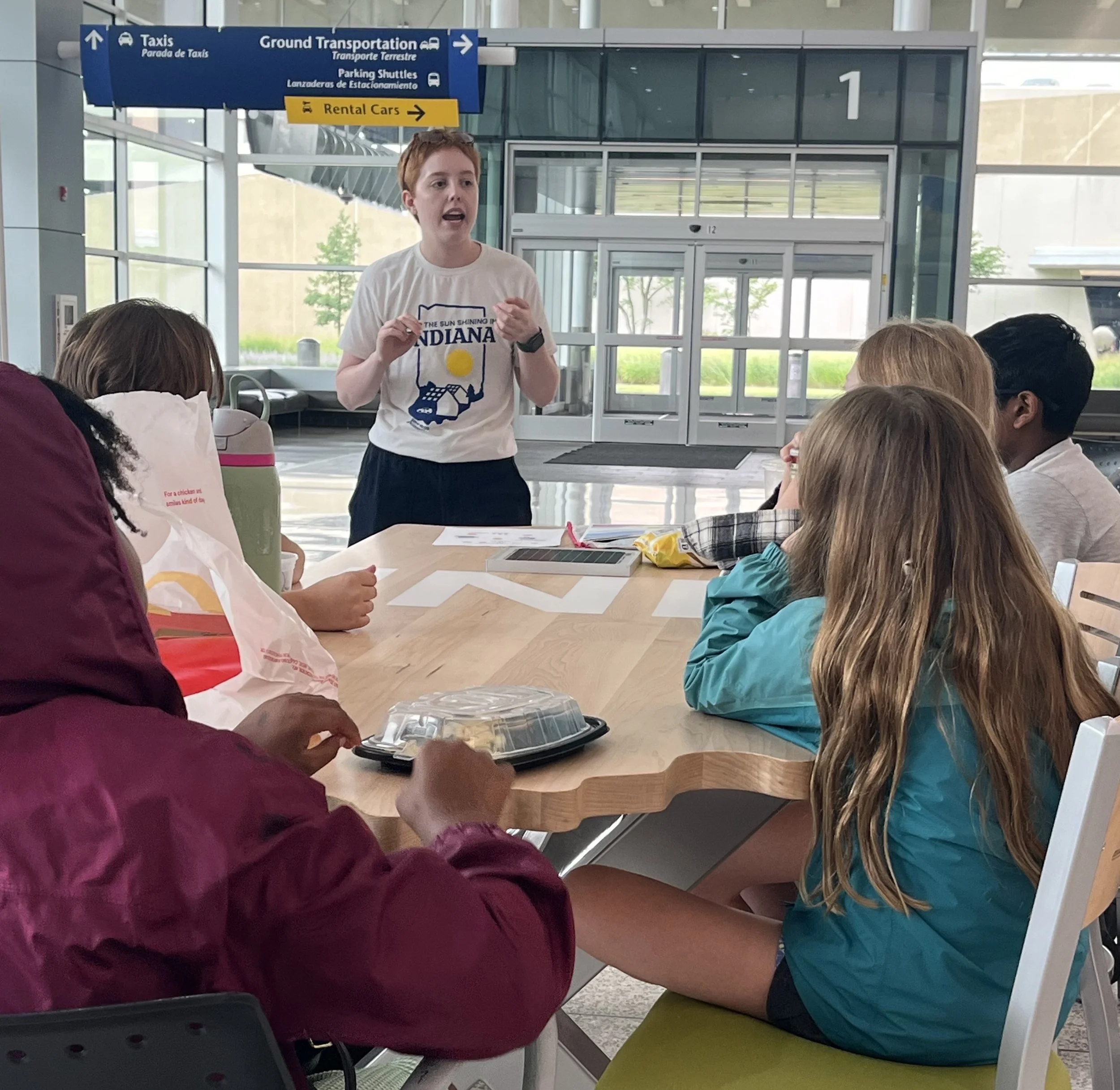
This summer, the author (above) talked to camp students about community solar — students at around the age when Jamie began learning about solar at camp. The setting of this impromptu “classroom” is the Indianapolis International Airport, which features the largest airport-based solar farm in the world. Note: Jamie and the students traveled to the airport via the IndyGo bus system. Provided photo. (For more YEPT coverage of camps, go here.)
Indiana Needs Community Solar!
Over twenty other states have enacted legislation for community solar, including neighboring states like Illinois and Minnesota as well as traditionally conservative states like Alaska. It’s time for Indiana to join them in building up communities. Indiana is falling behind, and, without action, we risk becoming less competitive in clean energy, one of the largest growing industries.
Hoosier Environmental Council reports that Indiana ranks among the highest states for carbon emissions per capita and ranks #45 in air quality. Community solar helps lower emissions, improving air quality and health, without requiring major infrastructure changes.
SUN’s Director of Community Access, Diana Eddowes, makes an excellent point that Indiana has a significant history of industry and pollution, particularly in the vicinity of the Great Lakes. This damage is directly related to fossil fuels and our current energy system. She believes that community solar is a great way to begin repairing the harms done to those communities.
Eddowes sums it up perfectly: “I think community solar is a no-brainer. It benefits everyone.”
Hoosiers across the state are working toward enabling community solar. Check out these actions provided by Hoosiers for Community Solar and Solar United Neighbors to get involved and tell your legislators to join the fight for accessible, affordable energy!
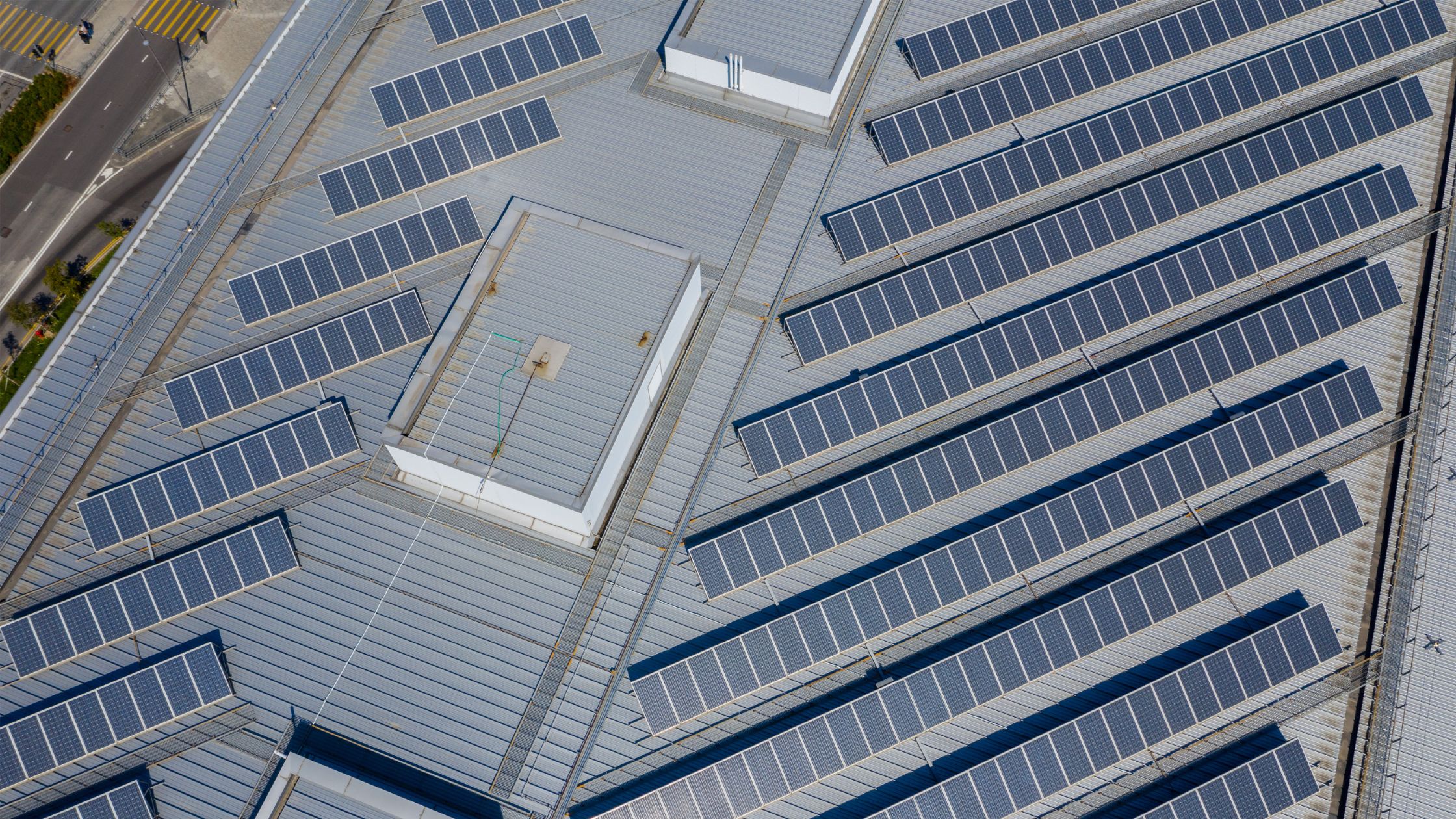
Indiana is full of wide-open, flat rooftops—on big-box stores, distribution centers, and warehouses—just waiting to be put to use. According to a recent Indiana Public Media story, these commercial rooftops represent an underutilized opportunity for solar development in our state. With high visibility, proximity to population centers and existing grid connections, they’re a natural fit for helping Indiana build a more resilient, reliable and local clean energy supply.
But if Indiana doesn’t get serious about fixing our outdated solar policies, that potential could go to waste—and Hoosiers will miss out on the savings and sustainability benefits solar power offers.
Net Metering Was the Foundation for Solar Growth
For years, net metering was one of the most effective tools for encouraging solar adoption. It allowed homeowners and businesses with rooftop solar to earn full retail credit for the excess energy they sent back to the grid. This made investing in solar financially viable for more people and helped Indiana build a more diverse and distributed energy system.
But in 2017, Indiana began phasing out net metering. The policy was replaced with the Excess Distributed Generation (EDG) rate, which compensates solar customers at a much lower rate than the value of the electricity they produce. For many, this made rooftop solar a far less attractive investment.
Restoring net metering, or at least creating a more equitable replacement, is essential if we want to see solar take off again, especially on those massive commercial rooftops that dot our landscape. When businesses know they’ll be fairly compensated for the clean energy they generate, they’re more likely to invest. That means more local power, more jobs and more savings on electricity bills.
Community Solar Brings Clean Energy to Everyone
Even with stronger net metering, rooftop solar won’t work for everyone. Many Hoosiers—especially renters, those with shaded roofs or households with limited income—simply can’t install solar panels at home. That’s where community solar comes in.
Community solar projects allow individuals and small businesses to subscribe to a shared solar installation—often located on landfills, open fields or even those big-box rooftops—and receive a credit on their monthly electric bill for the energy it produces. It’s a simple, scalable way to expand access to clean energy to people who have been left out of the rooftop solar boom.
Unfortunately, Indiana still lacks a statewide framework for independent community solar. That means utilities can block these projects,or make participation so complicated that they never get off the ground. A strong community solar policy—like the ones proposed earlier this year in the General Assembly—would change that by requiring utilities to connect community solar installations to the grid and to provide fair compensation to participants.
Big Rooftops, Bigger Opportunity—If We Take Action to Improve Our Energy Policy
From an economic standpoint, enabling solar installations on commercial rooftops just makes sense. These large, sunny surfaces are typically close to where the electricity is needed, reducing transmission costs and improving grid reliability. Solar also creates good-paying jobs and helps protect Indiana families and businesses from volatile fossil fuel prices.
But without policy changes—like restoring net metering and enabling independent community solar—we risk squandering this opportunity.
Now is the time to act. With utility bills rising and public health worsening, Indiana can’t afford to wait. By making smart policy choices today, we can unlock a clean energy future that works for everyone—not just those with the right roof.
Tell Indiana lawmakers to support fair solar compensation and pass community solar legislation in the next legislative session so we can power a brighter, more affordable energy future for all Hoosiers.
Across the country, Republican lawmakers are charting a new course on clean energy policy—and they’re doing it with community solar.
A recent Canary Media article highlights a surprising and important trend: in red states like Georgia, Missouri, Iowa and Ohio, GOP legislators are pushing for community solar programs that give residents, farmers and small businesses access to clean, affordable energy without relying on traditional utility monopolies. Their message is clear: energy freedom and competition aren’t partisan. They’re practical, pro-growth policies that can lower costs, strengthen the grid and attract new investment at the state level.
From the story:
Twenty-five states have already adopted policies to enable community solar, according to an April report from the NC Clean Energy Technology Center. Nationwide, shared solar had its biggest growth spurt ever in 2024, rising 35% from 2023 to reach a cumulative 8.6 gigawatts of installed capacity, according to Wood Mackenzie. Now, the idea is gaining momentum among conservatives.
Not only are GOP lawmakers introducing and signing on to more community solar bills, but other local Republican stakeholders such as chambers of commerce, landowners, and conservative policy groups are also voicing their support, according to the national trade association Coalition for Community Solar Access. The libertarian group Americans for Prosperity is backing Iowa’s HF 404 — alongside Walmart. Last year, in Alaska, several GOP legislators voted for a community solar bill, and the state’s Republican governor signed it into law.
This momentum in conservative-led states has big implications for Indiana, where lawmakers face a critical decision. Will they follow the lead of their Republican colleagues in other states or continue to let utilities call the shots?
Red States, Renewable Energy, and the Power of Choice
As Canary Media reports, lawmakers in several conservative-controlled legislatures are embracing community solar as a market-driven, job-creating solution to energy challenges.
This trend isn’t about ideology. It’s about economics, competition and fairness. Republican lawmakers are responding to their constituents’ frustrations with rising utility bills, outdated infrastructure and lack of consumer choice.
From the story:
“Ultimately, for me, it was giving Iowan consumers a choice,” said Iowa state Rep. Hans Wilz, a Republican, in a March interview on why he introduced a community solar bill. Not everyone can afford to put solar panels on their roof, he explained: “This is a way for all Iowans to be able to participate in a solar program.”
Lawmakers are recognizing that enabling private investment in distributed energy—like community solar—aligns with core conservative values: limited government, local control and free-market solutions.
Indiana Is Falling Behind
While our neighbors are making progress, Indiana has yet to take meaningful steps to enable independent community solar. Legislation has been introduced multiple times—including House Bill 1581 and Senate Bill 541 in this most recent session—but nothing has passed. Utilities continue to oppose these efforts, arguing they will lose control of customers and revenue. But this resistance comes at a cost.
Right now, Hoosiers pay more for electricity than most Midwestern states. Indiana has seen five rate increases approved in the last five years, with more likely on the horizon. As energy-hungry tech companies like Amazon and Microsoft build data centers across the state, the demand for electricity is skyrocketing. Yet the only solutions on the table from utilities involve risky bets on small modular nuclear reactors and expensive infrastructure that ratepayers will ultimately fund even if the projects fail.
Community solar offers a better path. Unlike utility-scale projects, these smaller installations are financed with private capital, not ratepayer dollars. They generate electricity close to where it’s used, increasing grid efficiency and reducing peak demand. And best of all, they put customers in charge.
Lower energy bills: Studies show subscribers to community solar save between 10% and 15% on their electric bills.
Job creation: The solar industry already supports thousands of jobs in Indiana. Enabling community solar would expand that workforce, particularly in construction, electrical trades and maintenance.
Stronger economies: Community solar projects are often built on farmland or open space, providing farmers with a steady stream of lease income while keeping land in agricultural production.
Energy independence: With community solar, customers aren’t stuck with whatever price or source their monopoly utility provides. They have options, and that makes the whole system more resilient.
A Nonpartisan Solution for a Pressing Problem
Clean energy is not a partisan issue. If Missouri and Iowa Republicans can come together to pass meaningful reforms that expand energy access and reduce costs, there’s no reason Indiana lawmakers can’t do the same.
Supporting independent community solar isn’t about going green for green’s sake. It’s about protecting Hoosier wallets, empowering local communities and preparing for a future where every home, business and factory needs affordable power.
Indiana has a chance to join a growing national movement led by pragmatic, forward-looking legislators from both parties. But to get there, we need policymakers willing to stand up to utility interests and put Hoosiers first.
Let’s follow the lead of red states leading the clean energy charge — and bring community solar to Indiana.
In 2024, Indiana emerged as a national leader in solar energy growth, securing the 10th spot in the United States for new solar capacity additions. This remarkable achievement underscores the state’s commitment to renewable energy and its potential to transform its energy landscape.
A significant contributor to this growth is the Mammoth Solar project, located in Pulaski and Starke Counties. With a planned capacity of 1,600 megawatts (MW), it stands as one of the largest photovoltaic power installations in the United States. The first phase, Mammoth North, began construction in March 2022 and was completed in July 2024, adding 480 MW to the grid. This project alone is expected to power approximately 250,000 homes, showcasing the tangible benefits of large-scale solar investments.
Beyond utility-scale projects, Indiana is poised to bring activate than $100 million in funds to bring solar energy to low-income communities across the state under the Solar Opportunities Indiana program.
Designed to spur the deployment of residential distributed solar energy, Solar Opportunities Indiana, which is part of the federal “Solar for All” program, will lower energy bills for Hoosiers and catalyze transformation in markets serving low-income and disadvantaged communities.
The state’s overall solar capacity reached 3,539 MW by the end of 2024, ranking 16th nationally in total installed capacity. This capacity is sufficient to power approximately 428,674 homes, with solar energy accounting for 3.67% of Indiana’s electricity production. The sector also supports 4,103 jobs, a positive impact for the state’s economy.
Indiana’s ascent in the national solar rankings is a testament to the collaborative efforts of policymakers, businesses and communities. By embracing renewable energy, the state is not only reducing its carbon footprint but also fostering economic growth and energy independence.
Last year, the Solar Opportunities Indiana (SOI) program emerged as a beacon of hope, aiming to improve access to clean energy and foster environmental equality across the state. However, recent political shifts have cast uncertainty over the program’s future, leaving Hoosiers in a state of limbo regarding their clean energy aspirations.
The Rise of Solar Opportunities Indiana
In April 2024, the U.S. Environmental Protection Agency (EPA) awarded $117.4 million to Solar Opportunities Indiana, a coalition comprising municipalities, advocacy organizations, faith-based groups, educational institutions and renewable energy advocates. This funding, part of the EPA’s “Solar for All” initiative, was earmarked to expand equitable access to solar energy in low-income and disadvantaged Hoosier communities over a five-year span. Key initiatives under this program included direct financial assistance for solar installations, workforce development to cultivate a skilled solar industry workforce, community engagement to bolster public support and policy innovation to streamline solar market participation.
The announcement was met with widespread excitement. For many communities, this initiative represented not just an environmental advancement but also an economic opportunity. Lower energy bills, job creation and community empowerment were among the anticipated benefits.
A Sudden Halt: Funding Freeze and Its Implications
However, the momentum faced an unexpected challenge. In January 2025, President Donald Trump issued an executive order pausing billions of dollars in federal grants already legally allocated for clean energy projects approved and funded under the previous administration. This abrupt decision placed the future of programs like Solar Opportunities Indiana in jeopardy. Communities that had invested time and resources into planning and were on the cusp of implementation found themselves in a state of uncertainty.
For example, in Columbus, Indiana, a $4.42 million project aimed at providing solar energy to over 530 low- and moderate-income households hangs in the balance. A federal judge has ordered funding to proceed, but solar advocates are still unclear what the future will hold.
The Ripple Effect on Community Planning
The funding freeze has had a cascading effect on community planning and morale. Organizations and volunteers who had dedicated countless hours to these initiatives are now grappling with the possibility that their efforts may not come to fruition. This unpredictability hampers the ability of communities to strategize for a sustainable energy future, potentially deterring future participation in similar programs.
The Imperative for Community Solar Initiatives
The turbulence surrounding federal programs designed to help Hoosiers access renewable energy underscores a pressing need: the establishment and support of alternative solar energy avenues, including community solar projects. Community solar allows multiple participants to benefit from a single solar array, making solar energy accessible to those who may not have suitable rooftops or the financial means for individual installations.
By adopting policy that enables independent community solar, Indiana could mitigate the risks associated with political fluctuations and funding uncertainties. These projects can be tailored to local needs, ensuring that the transition to clean energy is both inclusive and resilient. Community solar and Solar Opportunities Indiana would work in tandem to create even more pathways to clean energy for Hoosiers.
Conclusion
While recent events have introduced uncertainty that hopefully will be resolved so that programs like Solar Opportunities Indiana can continue, they also illuminate the critical importance of diversifying and fortifying our approaches to clean energy adoption. Embracing community solar initiatives offers a viable path forward, ensuring that all Hoosiers, regardless of economic standing, can partake in and benefit from Indiana’s sustainable energy future.
Community solar projects can be a powerful way to bring clean, renewable energy to local communities while creating economic and social benefits. A recent collaboration between Walmart and Nexamp to develop 31 community solar projects across five U.S. states is a great example of what’s possible when corporate leaders invest in renewable energy partnerships. These projects will not only power homes and businesses but also generate local jobs, reduce energy costs and strengthen regional energy resilience.
While this initiative is inspiring, it also serves as a reminder that Indiana currently lacks independent community solar legislation—a missed opportunity to replicate similar success stories here in the Hoosier State.
The Walmart-Nexamp Partnership: A Model for Community Impact
Walmart’s partnership with Nexamp highlights how large corporations can leverage their resources to drive community impact. The 31 projects announced will collectively bring affordable solar power to thousands of households and businesses, reduce reliance on fossil fuels and support local economies through job creation and infrastructure development. By subscribing to these community solar programs, participants can save on their energy bills while contributing to a cleaner, healthier environment.
These projects demonstrate the importance of having policies and frameworks in place to enable such initiatives. States like New York and Illinois have embraced community solar in a way that allows partnerships between private companies and local communities to flourish. The result? A win-win scenario for businesses, residents and the environment.
What Indiana Can Learn From This
Indiana is seeing record growth in clean energy jobs and has the potential to become a leader in renewable energy, but without dedicated community solar legislation, the state could fall behind. Independent community solar policies would enable:
Accessible Clean Energy for All: Community solar allows renters, homeowners with shaded roofs and others who can’t install solar panels to benefit from renewable energy.
Economic Growth: Community solar projects can drive local job creation, from construction and maintenance to administrative roles.
Energy Independence: By diversifying our energy sources, Indiana can reduce our reliance on out-of-state energy providers and strengthen our grid.
Corporate Investment: Forward-thinking legislation could attract companies eager to invest in projects that align with their sustainability goals.
Why Now Is the Time for Action
Indiana is already seeing growing interest in renewable energy from businesses and residents alike. By enacting independent community solar legislation, policymakers can unlock opportunities for both urban and rural communities to thrive. As Walmart’s investment shows, these partnerships can drive tangible benefits—but the foundation must be laid through smart policy.
Let’s take the lead from states that have embraced community solar and work toward creating a framework that allows these transformative projects to flourish in Indiana. The future is bright, and it’s time for Hoosiers to harness the power of the sun to build stronger, more resilient communities.
1. What is Community Solar? Community solar allows families, businesses and organizations to subscribe to a portion of solar energy produced by a shared solar facility. This model provides credits on utility bills based on the amount of energy generated. Importantly, community solar is funded through private capital, not ratepayer dollars, aligning with Indiana’s energy policy goals, such as reliability, affordability and environmental sustainability.
2. Who Can Participate? Community solar is inclusive, allowing a wide range of Hoosiers to participate. Homeowners, renters, low-income families, small businesses, schools, farms and even local governments can join. This inclusivity makes it accessible to traditionally underserved populations, offering broader access to solar energy benefits.
3. Energy Freedom and Economic Growth Community solar empowers Hoosiers with energy freedom—allowing consumers to choose how they get their power. It also fuels economic growth. The solar industry is booming, and Indiana is expected to see a nearly 30% increase in clean energy jobs over the next five years. Community solar opens new opportunities for businesses and residents while strengthening the state’s economy.
4. A Solution for Landowners and Brownfields Community solar presents exciting opportunities for farmers and landowners. Farmers can lease their land for solar development, diversifying their income. Additionally, community solar can be installed on brownfields or other hard-to-repurpose land, making it a flexible solution for common property-related challenges.
5. Energy Resiliency and Local Benefits By producing energy locally, community solar reduces Indiana’s reliance on out-of-state or foreign energy sources, enhancing the state’s energy resiliency. This means lower energy costs and greater grid stability. Furthermore, the program promotes participation from excluded communities, creating environmental and economic benefits right here in Indiana.
Community solar is a powerful tool to drive clean energy, economic growth, and inclusivity in Indiana.
Sometimes a news story comes along that has the perfect headline and offers the perfect explanation for why community solar is so needed across our country—and in Indiana—right now.
NPR recently published a piece on federal funding available through the “Solar for All” program that will help ensure low-income residents have access to solar energy that can lower their utility bills and improve other quality of life issues in local communities.
Rooftop solar adopters still tend to be wealthier than their neighbors. Rooftop solar panels and installation have a median cost of around $30,000 before government incentives, according to Lawrence Berkeley National Laboratory (LBNL). But prices for panels and installation are falling, and with more leasing and loan financing programs, there’s “a slow but steady movement” toward more low-income homes with rooftop solar, says Galen Barbose, staff scientist at LBNL.
The Solar for All grants aim to speed up that shift, says David Widawsky, director of the EPA’s Office of the Greenhouse Gas Reduction Fund, which manages the program.
But it isn’t just rooftop solar. Widawsky says the money will also go toward batteries that allow solar customers to store their energy. And it will go toward community solar, which allows customers to tap into solar generated at a shared site, like a solar farm.
Earlier this year, Indiana found out the state would receive more than $100 million in funding through the “Solar for All” program.
As part of these awards, a coalition of Indiana organizations and commissions was awarded nearly $117.5 million.
The Indiana Solar for All Coalition includes the Indiana Community Action Association, the Indiana NAACP and the cities of Fort Wayne, Gary and Indianapolis.
The funding will be used to create new incentives for solar energy for low-income residents and contribute to home energy savings. The award money will also go toward community solar installations, which provides solar energy access to multi-family homes, renters and those without ideal roof spaces.
The federal “Solar for All” program will open up significant new opportunities for low-income residents and renters across Indiana to access the benefits of solar energy.
Traditionally, solar energy has been out of reach for many in these communities due to the high upfront costs of installation and the lack of homeownership, which prevents renters from making such investments.
The “Solar for All” program aims to address these barriers by providing funding and support for community solar projects, where residents can subscribe to a shared solar array and receive credits on their electricity bills. This not only makes solar energy more accessible but also allows participants to save on their energy costs, contributing to economic relief for low-income households.
By making solar energy more inclusive, “Solar for All” will help bridge the equity gap in Indiana’s energy landscape, ensuring that all residents, regardless of income or housing status, can participate in and benefit from the state’s move toward a more sustainable future.
When we talk about community solar, we typically only talk about developments that will help residential energy customers and small businesses.
But what if community solar projects also involved household brand names? Those projects are happening across the country. Here’s an example from a fast food giant that’s got stores from coast to coast:
Over 130 Wendy’s restaurants in New York, Illinois, and Massachusetts are now sourcing between 30% and 100% of their energy from community solar.
Community solar provider Ampion Renewable Energy is partnering with The Wendy’s Company to help nearly 100 company-operated restaurants and nearly 40 franchise restaurants source renewable energy.
The participating restaurants are enrolled in Ampion+, which enables community solar subscribers to access Renewable Energy Certificates (RECs).
Strong community solar legislation will allow for the kind of independent projects that help communities at the local level, from unused parking lots to warehouse rooftops to landfills to box stores and fast food chains.
Community solar has the ability to transform spaces, breathing new life into previously unseen spaces while advancing the transition to clean energy. By embracing community solar initiatives, communities can not only reduce their carbon footprint but also foster economic growth and community resilience. It’s time to harness the power of the sun and embark on a journey towards a brighter, more sustainable future.
Don’t miss this great column from Bruce Stewart, President and CEO of Perch Energy, on how community solar can help low-income residents lower their energy bills:
Tens of thousands of households and businesses are already subscribed to community solar projects, and they’re saving money on their electricity bills and contributing to a less fossil fuel-dependent energy system. Bolstered by prevailing wage requirements in their construction and guaranteed savings for participants, our industry is democratizing solar by making it accessible to more economic classes, including for those who lack the space or resources to invest in panels themselves while also creating well-paying jobs.
Critically, community solar programs are increasingly focused on ensuring these energy bill savings are shared with low-income households, with many states reserving capacity for them. The median household spends about 3% of their annual income on energy costs, whereas lower-income households sometimes pay as much as 14%. For these LMI households, community solar is an effective policy lever that provides breathing room in the household budget where it’s needed most.
But it’s not all sunshine and roses just yet. Inflation has remained persistent, squeezing low-income households on every front. While low-income households are beginning to participate more than in the early years of the community solar, there remains a glaring access gap: millions of extremely low-income (ELI) families living in master-metered affordable housing are structurally barred from using community solar in many jurisdictions. These are households with annual incomes at or below 30% of the area median income.
As momentum for clean energy grows, community solar programs have emerged as a powerful tool for reducing energy costs and promoting sustainable practices.
However, monopoly utility companies often present significant challenges, using their influence to block access to these beneficial programs. It is crucial for advocates to help policymakers understand the value and mechanics of independent community solar to effectively counter these anti-consumer arguments.
This story highlights how monopoly utility companies in California are actively working to limit access to community solar. These companies argue that community solar threatens their business model and could lead to increased costs for non-participating customers.
However, these claims obscure the larger benefits of community solar. Independent community solar programs allow multiple households to share the benefits of a single solar installation, providing access to renewable energy without the need for individual rooftop panels.
This model not only reduces energy costs for participants but also promotes energy equity by making solar power accessible to a broader segment of the population, including those who may not have suitable rooftops for solar panels.
Policymakers play a vital role in fostering the growth of community solar. By understanding the mechanics and benefits of independent community solar programs, they can craft legislation that supports these initiatives. Advocates for community solar can use these messages to help make their case to policymakers:
Consumer Savings: Emphasize the substantial cost savings that community solar programs offer to consumers. Highlight real-world examples and data showing the financial benefits to participants.
Energy Equity: Stress the importance of making renewable energy accessible to all, including low-income households and those living in multi-family buildings or areas unsuitable for individual solar installations.
Environmental Impact: Highlight the environmental benefits of community solar, including the reduction of greenhouse gas emissions and the promotion of sustainable energy practices.
Economic Growth: Point out the potential for job creation and local economic growth associated with the development of community solar projects.
By focusing on these messaging points, advocates can build a compelling case for independent community solar and counter the anti-consumer rhetoric of monopoly utility companies. Understanding and advocating for community solar is not just about promoting clean energy; it’s about ensuring a fair, equitable and sustainable energy future for all.
You can help share out the benefits of community solar programs using the resources here.
This is not a community solar story, per se, but it’s a story about how solar energy and panels can be deployed in places you might not imagine and bring unexpected benefits to neighborhoods, all the while lowering energy costs for a community itself.
The Associated Press reports:
Detroit is using something it has plenty of — vacant land — to produce something the city needs — clean and relatively inexpensive energy.
Pending approval by the City Council, Kobylski’s Gratiot-Findlay neighborhood eventually will see solar arrays on about 23 acres (9.3 hectares) of land. Not far away, another eastside neighborhood is to get arrays on nearly 41 acres (16.5 hectares), while a third will get arrays on nearly 40 acres (16.1 hectares).
Five other neighborhoods are finalists to also get solar arrays. Resident groups had to apply to be considered for the program.
The city is looking to build solar energy arrays on about 200 acres (81 hectares). The arrays would produce enough clean energy to offset the electricity used currently by 127 municipal buildings.
Detroit will use $14 million from an existing utility fund for up-front costs that include acquiring and clearing the land. The solar fields are expected to ultimately save the city $4.4 million per year.
Repurposing unused land in urban areas for solar energy projects offers a sustainable solution to urban decay while promoting renewable energy. These projects in other areas could be structured as independent community solar initiatives, bringing transformative benefits to cities beyond Detroit.
By converting vacant lots and underutilized spaces into solar farms, cities could address multiple challenges, including energy poverty, urban blight and environmental sustainability.
In many urban areas, particularly those with significant amounts of unused or abandoned land, community solar projects can provide affordable, clean energy to residents who might not have the resources to install solar panels on their own properties. This democratizes access to renewable energy, allowing low-income families to benefit from reduced electricity bills and increased energy security. Furthermore, these projects can create local jobs in the construction, maintenance and operation of solar arrays, contributing to economic revitalization in underserved communities.
By transforming blighted areas into productive, green spaces, these cities can enhance urban resilience and improve public health through reduced air pollution. Additionally, community solar projects can serve as educational hubs, fostering community engagement and awareness about renewable energy and sustainability practices.
Implementing such projects requires collaboration between city governments, local organizations and private investors. Policy support and incentives at the municipal and state levels can further encourage the development of community solar, ensuring that these projects are economically viable and widely accessible.
As more cities embrace this approach, the collective impact on reducing carbon emissions and promoting environmental justice could be substantial, paving the way for a more sustainable and equitable urban future.
A new study from Lawrence Berkeley National Labs (LBNL) illustrates the transformative potential community solar projects have to advance energy equity. The report highlights how these projects not only democratize access to clean energy but also foster significant social and economic benefits for underserved communities.
For the first time, the researchers combine household-level data from Berkeley Lab’s Tracking the Sun rooftop solar adopter data set with data compiled under NREL’s Sharing the Sun community solar research, as well as additional community solar adopter data collected for the study. To determine how well community solar is serving the needs of those who are underserved by the rooftop solar market, the study looked at the demographic characteristics of the two adopter groups.
Based on a sample of 11 states, the LBNL study found that community solar adopters in 2023 were about 6.1 times more likely to live in multifamily buildings than rooftop solar adopters, 4.4 times more likely to rent, and earned 23% less annual income. Based on this, the researchers conclude that community solar has effectively expanded solar access to multifamily housing occupants, renters and low-income households.
Community solar projects allow multiple households, businesses and organizations to share the benefits of a single solar array. This model is particularly advantageous for those who may not have the resources to install solar panels on their own properties, such as renters, low-income families and those living in shaded areas.
The new report underscores that community solar is more than just an environmental initiative; it’s a vehicle for social change. By pooling resources and leveraging economies of scale, community solar projects make renewable energy accessible and affordable to a broader segment of the population.
Key Findings of the Report
The report, a collaborative effort by various energy and social justice organizations, outlines several key benefits of community solar:
Increased Accessibility: Community solar projects break down the barriers to solar adoption, providing equitable access to clean energy for all socio-economic groups.
Economic Benefits: Participants in community solar projects can see significant savings on their energy bills. These savings are particularly impactful for low-income households, helping to reduce energy poverty.
Environmental Impact: By increasing the adoption of renewable energy, community solar projects contribute to a reduction in greenhouse gas emissions, supporting broader environmental and climate goals.
Social Cohesion: These projects foster a sense of community and shared purpose, as participants collectively contribute to and benefit from local renewable energy production.
Job Creation: The development and maintenance of community solar projects create local jobs, boosting the economy and providing new opportunities in the green energy sector.
What Hoosiers For Community Solar Supports
As a coalition, we are working to enable independent community solar as a tool to make the benefits of renewable energy accessible to all Hoosiers.
It’s clear that local clean energy is our future, but it needs to be the future for every day Hoosiers—not just big companies and utilities. Our shared vision is a statewide policy that supports:
Community and other independent ownership of community solar
Tangible savings for subscribers
Competitive and transparent markets for community solar development
Equitable access to the benefits of community solar for all Hoosiers
Looking Ahead
As the world grapples with the twin challenges of climate change and social inequality, community solar projects offer a viable solution that addresses both issues simultaneously. The findings of this report highlight the need for a concerted effort from policymakers, industry stakeholders and the community at large to support and expand these initiatives.
By prioritizing community solar, we can create a more equitable and sustainable energy future for all. This report serves as a timely reminder that the path to energy equity is paved with innovation, collaboration and a shared commitment to progress.
Artificial intelligence (AI) is revolutionizing various industries, and the solar energy sector is no exception. As solar companies strive to optimize their operations and enhance customer satisfaction, AI offers innovative solutions to predict and plan for customer needs more effectively. This technological advancement is particularly significant for community solar projects, where managing subscriber bases and promoting equity are top priorities.
AI in Community Solar Projects
Community solar projects are designed to provide solar energy access to a broader audience, including those who may not have the means to install solar panels on their own properties. These projects rely on a complex web of subscribers, each with unique energy consumption patterns and preferences. Managing this diverse subscriber base can be challenging, but AI is stepping in to simplify the process.
A recent article on Energy News highlights how community solar developers are leveraging AI to manage subscribers more efficiently. By analyzing data from various sources, AI algorithms can predict energy consumption patterns, helping companies tailor their services to meet individual customer needs. This not only improves customer satisfaction, but also ensures that energy production aligns more closely with actual demand, reducing waste and enhancing overall efficiency.
Advancing Equity Through AI
One of the most promising aspects of AI in community solar projects is its potential to advance equity. Traditionally, solar energy has been more accessible to wealthier individuals and those living in suitable geographical locations. However, AI can help identify underserved communities and design targeted initiatives to bring solar energy to these areas.
According to Latitude Media, community solar projects are increasingly using machine learning to map out areas with high potential for solar adoption but low current usage. This enables companies to focus their outreach and marketing efforts on these communities, ensuring a more equitable distribution of solar energy benefits.
Furthermore, AI can assist in creating flexible subscription models that cater to the financial capabilities of different customer segments, making solar energy more accessible to low-income households.
Predictive Maintenance and Grid Management
AI’s predictive capabilities extend beyond customer management. Solar companies also are using AI to monitor the health of their solar installations and predict maintenance needs. By analyzing data from sensors and historical performance records, AI can identify potential issues before they become significant problems, reducing downtime and maintenance costs.
Moreover, AI can optimize grid management by predicting fluctuations in energy production and consumption. This is particularly important for integrating solar energy into the broader energy grid, which requires careful balancing to prevent outages and ensure a stable supply of electricity. By forecasting these fluctuations, AI helps solar companies and grid operators maintain a reliable and efficient energy system.
The Future of AI and Solar Energy
The integration of AI into the solar energy sector marks a significant step forward in optimizing operations, enhancing customer satisfaction and promoting equity.
For community solar projects, in particular, AI may offer a powerful tool to manage subscribers, predict energy needs and ensure that the benefits of solar energy are distributed more equitably. As AI technology continues to evolve, its impact on the solar industry is likely to grow, paving the way for a more sustainable and inclusive energy future.